






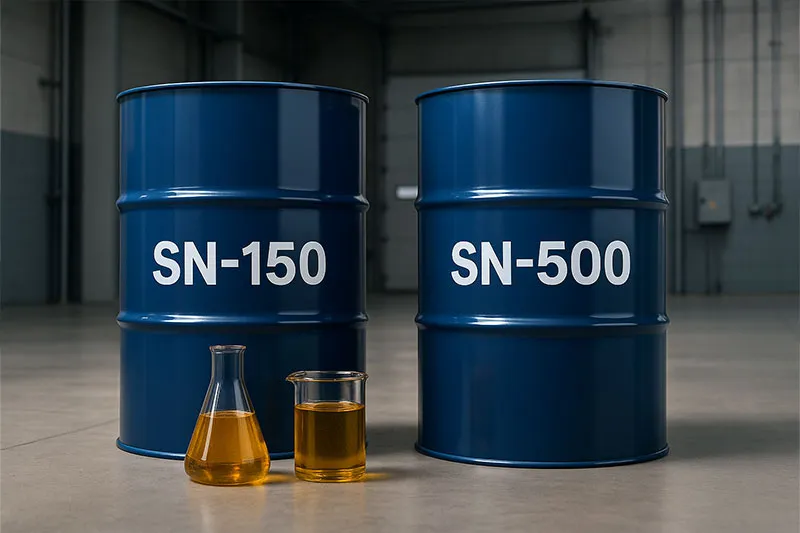
Base Oil SN-150 vs SN-500: Which Grade Fits Your Lubricant Needs?
Introduction
Choosing the right base oil grade is a critical decision for lubricant manufacturers, blending plants, and industrial operators. Among the most commonly used grades are SN-150 and SN-500. Each offers unique properties in terms of viscosity, volatility, and performance.
In this article, we’ll break down the differences between SN-150 and SN-500, their applications, and how to select the optimal grade for your operation.
What Is Base Oil?
Base oil is the primary raw material used in the formulation of lubricants for engines, machinery, and hydraulic systems. It acts as a carrier fluid for additives and plays a key role in determining the final lubricant’s performance.
Base oils are typically refined from petroleum and are categorized into different groups (Group I, II, III, etc.) and viscosity grades such as SN-150, SN-500, and SN-600.
SN-150: Light Viscosity Base Oil
Properties:
- Kinematic viscosity @100°C: ~5 cSt
- Viscosity Index: ≥90
- Flash Point: ≥200°C
- Pour Point: ~ -6°C
Applications:
- Automotive engine oils (low-viscosity blends)
- Hydraulic fluids
- Two-stroke oils
- Textile and process oils
- Transformer oils
Advantages:
- Flows easily at low temperatures
- Better fuel economy in engine oils
- Ideal for cold climate formulations
SN-500: Medium-Heavy Viscosity Base Oil
Properties:
- Kinematic viscosity @100°C: ~11 cSt
- Viscosity Index: ≥87
- Flash Point: ≥235°C
- Pour Point: ~ -3°C
Applications:
- Gear oils and transmission fluids
- Diesel engine oils
- Hydraulic systems operating under high pressure
- Industrial lubricants and greases
Advantages:
- Offers better load-carrying capacity
- Improved film strength at high temperatures
- Suitable for warmer environments
SN-150 vs SN-500: Quick Comparison
| Property | SN-150 | SN-500 |
|---|---|---|
| Viscosity (100°C) | ~5 cSt | ~11 cSt |
| Flash Point | ≥200°C | ≥235°C |
| Pour Point | ~ -6°C | ~ -3°C |
| Applications | Light oils, cold regions | Heavy-duty oils, warm climates |
| Flow Characteristics | Excellent | Moderate |
| Load-Bearing Strength | Lower | Higher |
Which One Should You Choose?
If you’re manufacturing light-duty lubricants that must perform in colder temperatures, SN-150 is likely your best bet.
However, for high-load applications or use in warmer climates, SN-500 offers greater stability and film strength.
Tip: Many lubricant formulations blend both SN-150 and SN-500 to balance performance, economy, and temperature range.
Packaging & Export Solutions
We supply both SN-150 and SN-500 in:
- Bulk shipments
- New steel drums
- Flexitanks
Our products are inspected by global firms like SGS and are ready for fast delivery to over 15 countries.
👉 Explore all Base Oil Products or Contact Us to request a quote.
Top 10 FAQs on SN Base Oils
1. What is the full form of SN in base oils?
SN stands for Solvent Neutral, referring to the refining process used to produce Group I base oils.
2. Is SN-150 suitable for engine oils?
Yes, SN-150 is ideal for light-duty engine oils, especially in colder environments.
3. Can SN-500 be blended with SN-150?
Absolutely. Many formulations use both grades to balance viscosity and performance.
4. What’s the flash point difference between SN-150 and SN-500?
SN-500 has a higher flash point (≥235°C) than SN-150 (≥200°C).
5. Is SN-500 better for heavy-duty applications?
Yes, due to its higher viscosity and load-bearing capacity.
6. What is the typical packaging for SN base oils?
Available in bulk, flexitanks, or steel drums.
7. Are SN-150 and SN-500 Group I base oils?
Yes, both are classified as Group I base oils.
8. Which base oil grade is better for fuel efficiency?
SN-150 provides better fuel economy due to lower viscosity.
9. Can SN-500 be used in hydraulic systems?
Yes, especially where higher viscosity and pressure resistance are required.
10. Do you provide custom packaging for export?
Yes, including labeling and drum branding based on client needs.

One Response