






Residue Wax vs Paraffin Wax: A Technical Guide for Industrial Buyers
Includes internal links, detailed comparison, Westinol promotion, and a closing FAQ section.
Introduction
In industrial manufacturing, wax selection plays a critical role in determining the performance, processability, and product finish of the end material. Two widely used waxes—Residue Wax and Paraffin Wax—often appear similar, but their composition, behavior, and industrial applications are vastly different.
This technical guide breaks down the distinctions between Residue Wax and Paraffin Wax, helping procurement managers, manufacturers, and formulation chemists make informed purchasing decisions.
Westinol proudly supplies both Residue Wax and Paraffin Wax, backed by international quality assurance and flexible export packaging.
What Is Paraffin Wax?
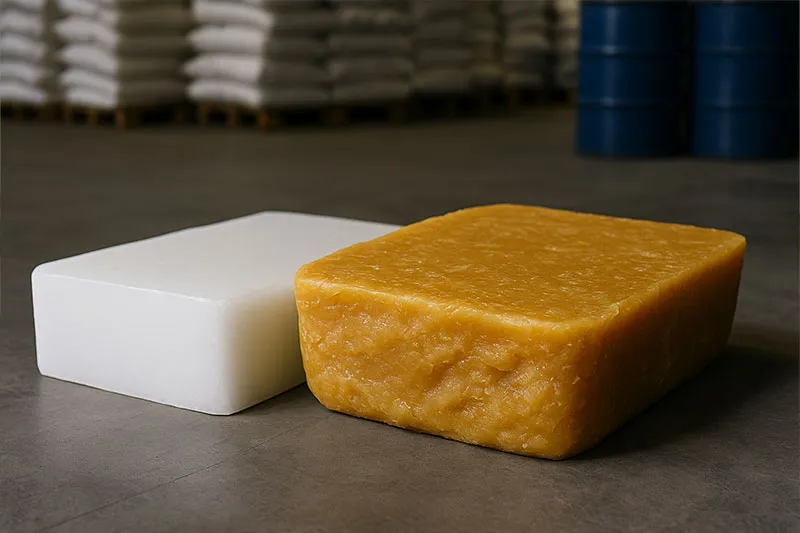
Paraffin Wax is a highly refined hydrocarbon wax derived from petroleum. It is generally white, odorless, and odor-neutral, with a high melting point and low oil content.
Key Characteristics:
- Purity: Highly refined (oil content typically 0.5%–3%)
- Appearance: White, crystalline solid
- Melting Point: ~59–65°C
- Flash Point: ≥240°C
- Applications: Candles, cosmetics, food packaging, insulation, pharmaceuticals
Paraffin wax undergoes rigorous de-oiling, filtration, and bleaching processes—making it suitable for high-purity and FDA-compliant applications.
What Is Residue Wax?
Residue Wax is a semi-refined by-product recovered during paraffin wax production, especially from slack wax and deoiling units.
Key Characteristics:
- Composition: Mixture of paraffin wax + unfiltered oil and residue
- Oil Content: Ranges from 10–35%
- Appearance: Yellow to brown semi-solid
- Melting Point: ~45–60°C
- Flash Point: ~200–240°C
- Applications: Rubber, matchstick coating, textile sizing, board polishing, waterproofing, industrial adhesives
Residue wax is more cost-effective and ideal where visual aesthetics and high purity are not required, but lubricity and cost are priorities.
Residue Wax vs Paraffin Wax: Technical Comparison
| Property | Paraffin Wax | Residue Wax |
|---|---|---|
| Refinement Level | Highly refined | Semi-refined (by-product) |
| Oil Content | 0.5%–3% | 10%–35% |
| Color | White, translucent | Yellow to brown |
| Purity | Very high (FDA/food-grade options) | Moderate to low |
| Melting Point | 59–65°C | 45–60°C |
| Flash Point | ≥240°C | 200–240°C |
| Applications | Candles, cosmetics, pharma, packaging | Rubber, matches, board polish |
| Price | Higher | Lower |
Application Guidelines
Choose Paraffin Wax if:
- You need purity, stability, and aesthetics
- You manufacture candles, cosmetics, chewing gum base, food wrap, or pharma products
- You need a clean burn or food-safe contact material
Choose Residue Wax if:
- You are in rubber, matches, adhesives, or industrial formulations
- You need a cost-effective lubricant or waterproofing wax
- The wax is not used in cosmetic or food-contact applications
Packaging & Export Options by Westinol
We supply both types of wax in:
- Carton boxes, PP bags, or jumbo bags
- New steel drums
- Custom labeling and weight (20–25kg slabs or flakes)
Our products are SGS-inspected and available for bulk export to Asia, Africa, and the Middle East.
Explore:
Top 10 FAQs – Residue Wax vs Paraffin Wax
1. Is residue wax a cheaper version of paraffin wax?
Yes, it’s a by-product with higher oil content, hence lower cost.
2. Can I use residue wax for candle production?
It is not recommended for high-quality candles due to odor, smoke, and impurities.
3. Which wax has better thermal stability?
Paraffin wax, due to its higher refinement and higher flash point.
4. What does high oil content do in residue wax?
It increases lubricity and flexibility but reduces stability and appearance.
5. Is paraffin wax edible?
Only refined food-grade paraffin is safe for indirect contact, such as gum bases and packaging.
6. Where is residue wax used?
In rubber blending, polishing compounds, matches, and textile finishing.
7. Which wax is used in cosmetic creams?
Only refined paraffin wax is suitable for personal care.
8. Does Westinol export both waxes?
Yes, with multiple grades, packing options, and inspection certificates.
9. What is the shelf life of industrial wax?
Generally 3–5 years in proper storage conditions.
10. Can I blend residue wax with paraffin wax?
Yes, for custom formulations depending on end use.
Final Thoughts
Choosing between Residue Wax and Paraffin Wax depends entirely on your end-use, performance requirements, and budget. For high-end cosmetic, pharma, and food applications, Paraffin Wax is your go-to choice. For cost-sensitive industrial needs like rubber and matches, Residue Wax delivers value without compromising functionality.
👉 Explore all our wax products or contact us to get technical support and a custom quotation.

One Response