





Rubber Process Oil Explained: Types, Properties, and Global Suppliers
Introduction
Rubber Process Oil (RPO) is the unsung hero behind the smooth texture, flexibility, and performance of countless rubber-based products—from tires and hoses to conveyor belts, footwear, and industrial components. Whether your business involves compounding natural rubber or formulating high-performance synthetic elastomers, a solid understanding of RPO types, specifications, and sourcing is vital.
As a leading supplier, Westinol offers a comprehensive portfolio of Rubber Process Oils (RPO) in Light and Heavy grades, tailored to global standards. Dive into this detailed guide to learn RPO essentials and discover why Westinol should be your go-to partner.
What Is Rubber Process Oil (RPO)?
Rubber Process Oil (RPO) is a refined petroleum-derived oil added to rubber compounds to enhance processability, flexibility, and overall rubber performance. It acts as:
- A plasticizer, softening the compound for easier mixing, molding, and extrusion .
- A lubricant, reducing internal friction between polymer chains during processing .
- A cost-effective extender, partially replacing more expensive polymers without compromising quality .
Applications span across industries including tire manufacturing, automotive rubber parts, conveyor systems, flooring, and various molded rubber goods .
Types of Rubber Process Oil
RPO is typically classified by refining source and chemical composition:
1. Aromatic RPO
- High aromatic hydrocarbon content (often >35%).
- Excellent solvency and compatibility with natural rubber and SBR compounds.
- Frequently used in tires, gaskets, tubes, and re-treaded products.
- Environmental and health concerns due to polycyclic aromatic hydrocarbons (PAHs) are increasingly prompting shifts to safer alternatives .
2. Naphthenic RPO
- Moderate aromatic content; excellent solvency and color stability.
- Great low-temperature flexibility and compatibility with CR and NBR rubbers.
- Preferred where regulatory compliance (low PAHs) and performance are priorities.
3. Paraffinic RPO
- Comprised mostly of saturated hydrocarbons.
- High thermal and oxidative stability, low volatility, and high flash point.
- Ideal for EPDM, NR, heavy-duty hoses, and robust applications .
4. Eco-Friendly Low-PAH Alternatives
- TDAE (Treated Distillate Aromatic Extract), RAE (Residue Aromatic Extract), MES (Mild Extracted Solvent).
- Designed for low PAH content yet strong performance, increasingly adopted in tire compounding to meet stricter environmental standards.
Light vs. Heavy RPO Grades
Viscosity grading further refines RPO selection:
- Light‑ grade RPO: Kinematic viscosity (KV) ~20–30 cSt @100 °C.
- Heavy‑ grade RPO: KV ~30–50 cSt @100 °C .
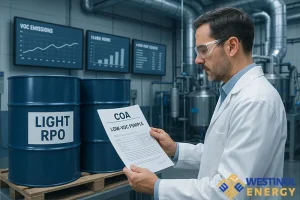
Light RPO suits colder climates and formulations needing enhanced flow and lower stickiness, while Heavy RPO supports hot environments and formulations demanding body and consistency.
Key Properties of RPO Types
| Property | Aromatic RPO | Naphthenic RPO | Paraffinic RPO | Low‑PAH (TDAE/RAE/MES) |
|---|---|---|---|---|
| Solvency | Excellent | Good | Moderate | Tailored moderate–high |
| Oxidation Stability | Moderate | Good | Very Good | Very Good |
| Volatility | Higher | Low | Very Low | Very Low |
| Low-temperature Behavior | Moderate | Excellent | Good | Excellent |
| Regulatory Compliance | Challenged by PAHs | Better (low PAH) | Best (low PAH) | Excellent (designed for low PAH) |
| Ideal Applications | Tires, re-tread, high solvency mixtures | Wide elastomer uses | Robust, hot settings | Eco-conscious tire manufacturing |
Global Market & Supply Trends
- The RPO market is growing steadily due to increased demand in automotive, industrial rubber goods, and regulatory pressure toward safer alternatives.
- Restrictive regulations on high-PAH oils (especially in Europe) create a strong push toward TDAE, MES, and RAE products.
- A relatively small group of large players (e.g., Shell, ExxonMobil, Nynas, Calumet) dominate global supply, with specialized suppliers emerging for niche low-PAH and performance grades .
Why Westinol Is Your Preferred RPO Supplier
At Westinol, we deliver:
- A diverse RPO portfolio, including Light and Heavy grades in Aromatic, Naphthenic, Paraffinic, and low‑PAH variants tailored to both performance and compliance.
- Global export capabilities with packaging in drums, bulk, and flexitanks.
- ISO-standard quality, with third-party testing and certifications.
- Technical support, guiding selection based on rubber type (NR, SBR, EPDM, CR, NBR) and processing conditions.
- Sustainable options, including eco-friendly TDAE and MES grades.
Application Cases
Tire Manufacturing
RPO enhances elasticity, reduces rolling resistance, and improves wear resistance. Westinol offers low-PAH TDAE grades for eco-conscious tire producers.
Footwear & Consumer Rubber Goods
Selecting the proper RPO (e.g., Naphthenic or Light Aromatic) ensures flexible soles and decorative rubber parts that last.
Industrial Belts & Hoses
Heavy Paraffinic RPO provides stability, durability, and consistency in demanding environments.
Automotive Sealing & Vibration Components
Naphthenic RPO offers premium compatibility and flexibility, critical for gaskets, seals, and vibration mounts.
Packaging & Logistics
Westinol offers flexible logistics for RPO delivery:
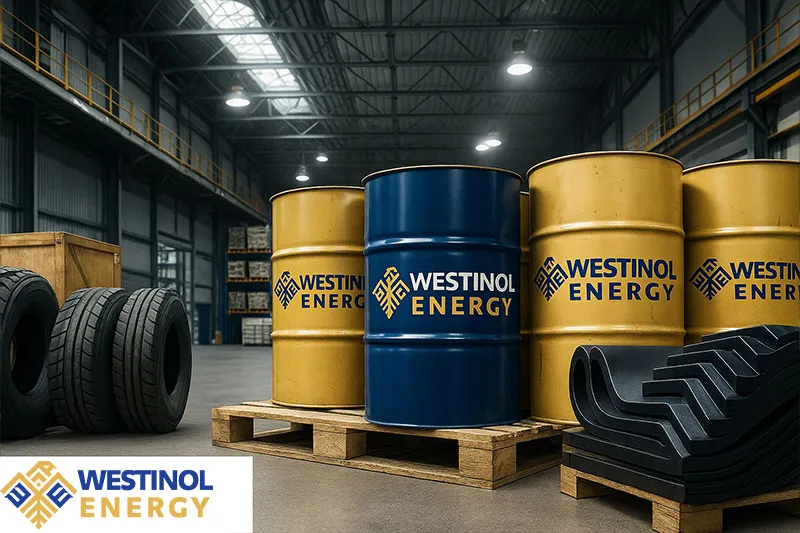
- New steel drums for small-to-medium orders.
- Flexitanks and bulk shipping for large-scale supply.
- Secure international logistics and compliance documentation for smooth customs clearance.
Learn more on our RPO product page.
Top 10 FAQs – Rubber Process Oil
- What is RPO?
It is a refined oil used as a plasticizer, lubricant, and extender in rubber compounding. - Which types of RPO are available?
Aromatic, Naphthenic, Paraffinic, and low-PAH (TDAE, MES, RAE) variants. - How do “Light” and “Heavy” RPO grades differ?
By viscosity: Light (20–30 cSt), Heavy (30–50 cSt) at 100 °C. - Why are low-PAH RPOs important?
They help meet environmental regulations and reduce health risks, especially in tire production. - How does RPO benefit rubber processing?
Improves flow, filler dispersion, and mechanical properties while lowering production cost. - Can Westinol supply customized RPO grades?
Yes—contact our team to tailor viscosity, PAH levels, and packaging options. - Which RPO suits automotive tires best?
Low-PAH TDAE or optimized aromatic/naphthenic blends depending on performance needs. - Are there sustainability-friendly RPO options?
Yes—Westinol provides eco-friendly grades designed for compliance and performance. - What’s Westinol’s quality assurance for RPO?
Third-party inspection, consistent grading, and global supply capability. - How to order RPO from Westinol?
Visit the RPO product category page or contact sales for pricing and logistics.
Final Thoughts
Rubber Process Oil is a critical ingredient shaping the success of rubber products across industries. Understanding grades, properties, and applications empowers manufacturers to optimize performance, cost, and compliance.
With Westinol’s reliable, quality-driven, and environmentally conscious RPO supply, your business gains a partner ready for both technical and logistical excellence.