




The Chemical Backbone of Paraffin Wax: What Manufacturers Must Know
Introduction: Consistency, Compatibility, and Chemical Clarity
In a lab environment where one failed formulation can cost weeks of testing and thousands in development budget, understanding the molecular structure and compositional purity of paraffin wax is not a luxury—it’s a necessity. For R&D engineers and formulators, especially in lubricants, polymers, and additives, the chemical profile of paraffin wax directly influences compatibility, melting behavior, and product performance.
This guide provides a deep-dive into what makes paraffin wax functionally valuable, how it differs from slack wax, and what to ask your supplier (like (WE Co.)) before placing a technical-grade order.
What Exactly Is Paraffin Wax?
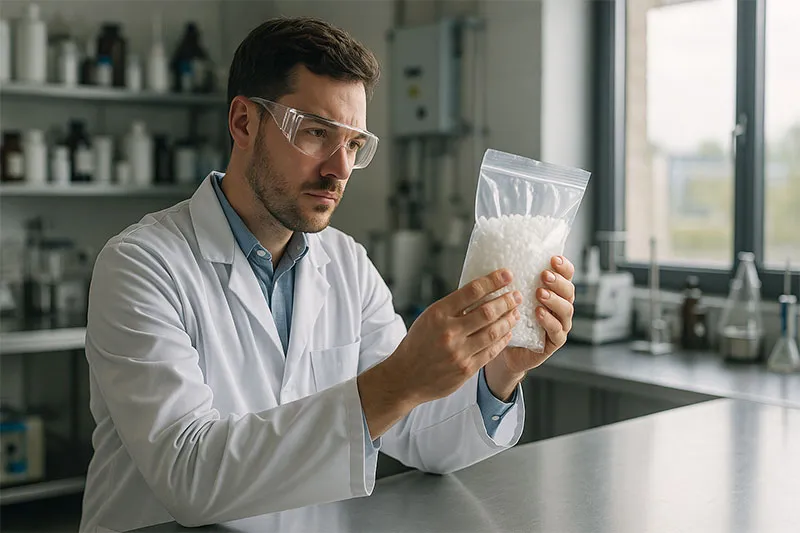
Paraffin wax is a white or colorless soft solid derived from petroleum via dewaxing processes. It is primarily composed of saturated hydrocarbons (n-alkanes), typically with 20–40 carbon atoms.
Key Characteristics:
- Chemical Composition: Linear alkanes with minimal branching (C20–C40)
- Melting Point: 46–65°C, depending on grade
- Oil Content: <1% in refined grades
- Congealing Point: ~60°C
- Applications: Candle making, cosmetics, food coatings, lubricants, hot-melt adhesives, PVC processing
In technical applications, paraffin wax’s purity determines compatibility with additives, stabilizers, or base fluids.
Slack Wax vs Paraffin Wax: Why the Difference Matters
One of the most common misconceptions in industrial sourcing is assuming slack wax is a cheaper version of paraffin wax. The difference is not just economic — it is chemical and functional.
| Property | Slack Wax | Paraffin Wax |
|---|---|---|
| Refining Stage | Intermediate | Final product |
| Oil Content | 5–20% | <1% |
| Color | Brownish to yellow | White / translucent |
| Purity | Mixed hydrocarbons | Mostly linear alkanes |
| Applications | Rubber, board, matches | Food, pharma, cosmetics |
Slack wax is a partially refined by-product containing more oil, unsaturated hydrocarbons, and impurities. While valuable in applications like particleboard manufacturing or waterproofing, it’s unsuitable for high-spec formulations.
Paraffin Wax vs Petroleum Jelly: Don’t Confuse the Use Case
Another frequent confusion occurs between paraffin wax and petroleum jelly. Both are petroleum-derived, but:
- Paraffin Wax is solid, crystalline, and used as a structural or phase-stabilizing agent.
- Petroleum Jelly is semi-solid, amorphous, and used primarily as a lubricant or moisture barrier.
They differ in molecular weight distribution, rheology, and cosmetic compatibility.
Technical Parameters That Should Be on Your Radar
For R&D teams, sourcing paraffin wax is not about just price. Here’s what to review before purchase:
- Oil Content (%wt): Aim for <0.8% for high purity applications
- Kinematic Viscosity @100°C: Affects melt behavior and blending
- Density @15.6°C: Impacts volumetric dosing
- Color (ASTM D-1500): Indicator of refining quality
- Flash Point (ASTM D-92): Indicates thermal safety
- Congealing Point (ASTM D-938): For phase-sensitive applications
Suppliers like (WE Co.) offer full CoA and third-party inspection (e.g., SGS) to guarantee parameter stability from batch to batch.
Paraffin Wax Spot Price: The Market Behind the Molecule
For purchasing teams, understanding the paraffin wax spot price helps forecast material cost and hedge against volatility.
- Influencing Factors: Crude oil trends, regional refining capacity, logistics disruptions
- Regions to Watch: Iran, India, China (key exporters)
- Recommended Practice: Sign quarterly contracts with transparent suppliers to stabilize cost over time
(WE Co.) provides competitive spot rates, especially for bulk or drum orders, with custom packaging options (PP bags, jumbo bags, cartons).
When to Choose Paraffin Wax Over Slack Wax
If your product demands:
- Minimal odor and color contamination
- Precise melt behavior
- Compatibility with polymers or food-contact materials
- Stable rheology over temperature ranges
Then paraffin wax is your only option. Slack wax may save cost, but introduces instability and inconsistency.
Related Resources
-
Residue Wax vs Paraffin Wax: A Technical Guide for Industrial Buyers
Subtle Brand Integration
When consistency matters more than cost, (WE Co.) delivers. With batch tracking, technical consultation, and customizable packaging, we help your R&D avoid formulation risks and your procurement avoid hidden costs.
Conclusion: Purity Is Not a Commodity
Paraffin wax might look simple, but chemically it’s a high-stakes input for R&D-driven production. For formulators, understanding what goes inside that solid block translates into performance outside it. Choose your grade. Choose your supplier wisely.
Need technical specifications or batch-specific CoA for your next formulation?
Contact (WE Co.) for:
- Product samples and technical datasheets
- Oil content and melt point consistency reports
- Custom packaging and shipping quotes
[Request Sample Now → Whatsapp]
FAQ
1. What is the difference between slack wax and paraffin wax?
Slack wax is a less refined by-product with higher oil content and impurities. Paraffin wax is purified and suitable for precise formulations.
2. Is paraffin wax safe for cosmetic or food applications?
Yes, provided it meets specific purity standards (<0.5% oil, certified by CoA), paraffin wax is widely used in lip balms, coatings, and polishes.
3. How do I check paraffin wax compatibility with my base polymer?
Run a solubility test and confirm melting behavior under shear. Request a sample with CoA from suppliers like (WE Co.) for lab-scale validation.
Contact Information
(WE Co.) – Westinol Energy
Email: westinol.com
Whatsapp: Whatsapp